

Why Sighthounds Need Martingale Collars
A practical guide to fit, safety and why martingale collars are especially suited to greyhounds, whippets, lurchers and other sighthounds.

A little about this guide
If you share your life with a Greyhound, Whippet, Lurcher or another sighthound, you’ll probably already know that their long necks and beautifully slim heads make them a little different when it comes to choosing the right collar.
Living with three rescue sighthounds — Barney, Harvey and Pumpkin — has taught me just how important a well-fitting collar can be, particularly for dogs who can be nervous, easily startled or prone to backing out of a traditional collar.
I created this guide to explain what a martingale collar is, why it can be particularly suited to sighthounds, how it should fit and how to use one safely. I’ll also share a little of what I’ve learnt from my own dogs along the way.
Whether you’re welcoming your first sighthound into your family or have shared your sofa with them for years, I hope you’ll find something useful here.
Sarah x
Founder & Maker, Snoods4Dudes
What is a martingale collar?
A martingale collar is designed a little differently from a traditional buckle or clip collar. Instead of fastening at a fixed size, it has two loops — a larger loop that sits around your dog’s neck and a smaller control loop where the lead attaches.
When your dog is walking on a loose lead, the collar sits comfortably around the neck. If they pull, become startled or try to back out of the collar, the smaller loop gently tightens the larger loop, helping to prevent the collar from slipping over the head.
Unlike a traditional slip lead or choke collar, a correctly fitted martingale has a limit to how far it can tighten. This is what makes the fit so important.
In simple terms:
A martingale is designed to sit comfortably when relaxed, but become more secure when your dog pulls or tries to back out.

Why are martingale collars so well suited to sighthounds?
Sighthounds have a distinctive shape. Breeds such as Greyhounds, Whippets and Lurchers often have long, slender necks and heads that are not much wider than their necks.
That elegant shape is part of what makes them so beautiful, but it can also mean that a traditional fixed collar is easier to slip out of — particularly if a dog suddenly stops, pulls backwards or becomes frightened.
A correctly fitted martingale offers a little extra security because it gently tightens when needed, helping to prevent the collar from passing back over the dog’s head.
This can be especially reassuring for newly rescued, nervous or easily startled sighthounds, where an unexpected noise or unfamiliar situation can sometimes cause them to try to back away.
A lesson I learnt from Pumpkin
Pumpkin came to us as a young rescue and, like many sighthounds, she can be easily startled by sudden or unfamiliar noises.
One experience in particular brought home to me just how important a secure, correctly fitted collar can be. We were walking near a busy road when a sudden noise frightened her and her instinct was immediately to back away.
It was one of those moments that stays with you — and a reminder that for some dogs, the right collar isn't simply about how it looks. It's about feeling confident that they're secure when something unexpected happens.
How should a martingale collar fit?
Correct fit is one of the most important parts of using a martingale collar safely. It should be loose enough to sit comfortably around your dog’s neck when relaxed, but adjusted so that it cannot slip over the widest part of the head when the control loop tightens.
When the lead is attached and gentle tension is applied, the two metal fittings on the control loop should move closer together without the collar becoming excessively tight around the neck.
You should always check the fit when you first put the collar on and regularly afterwards, particularly if your dog is young, has gained or lost weight, or has a particularly small head.
A good fit should:
-
sit comfortably when the lead is relaxed
-
tighten enough to prevent the collar slipping over the head
-
not continue tightening without a limit
-
allow the control loop to relax again as soon as tension is released
Never leave a martingale collar on an unattended dog, particularly in a crate or anywhere the control loop could become caught.
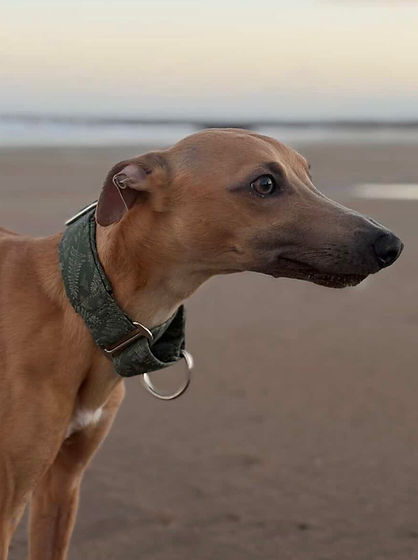
The martingale should sit comfortably when relaxed, with the control loop hanging loose when there is no tension on the lead.
Not sure which size you need?
Every dog is a little different, so taking a couple of simple measurements before ordering is always worthwhile.
Our Measuring & Sizing Guide explains exactly where to measure and how to choose the right size.
Which width of martingale collar should I choose?
1 inch
A lighter option that can work particularly well for smaller sighthounds, petite necks and growing puppies. For puppies, always check the fit regularly as their neck and head measurements can change quickly.
1.5 inch
A lovely middle ground and a popular choice for Whippets, smaller Lurchers and other
medium-sized sighthounds. It offers a little more width while still feeling light and comfortable to wear.
2 inch
The classic wide sighthound style. Particularly suited to Greyhounds, larger Lurchers and dogs with long necks where the extra width sits comfortably.
There isn't one width that's right for every sighthound. Comfort and fit should always come first — and if you're unsure, I'm always happy to help you choose.
Are martingale collars just for sighthounds?
Although martingale collars are particularly popular with sighthound owners, they aren't exclusively for sighthounds.
They can also be useful for other dogs whose head is similar in width to, or narrower than, their neck, and for dogs who have learnt that clever backwards wriggle out of a traditional collar.
The important thing isn't simply breed — it's choosing a collar that's appropriate for your individual dog and making sure it is correctly fitted.
While sighthounds will always have a special place at Snoods4Dudes, our martingale collars are handmade for dogs of many different shapes, sizes and breeds.
Frequently asked questions about martingale collars
Can a puppy wear a martingale collar?
Yes. A correctly sized and fitted martingale can be suitable for a puppy, including young sighthounds. Puppies grow quickly, though, so check the fit frequently and adjust or replace the collar as they grow.
Can my dog wear a martingale collar every day?
A martingale can be used for everyday walks when it is correctly fitted. However, because it includes a control loop that can tighten, I don't recommend leaving one on an unattended dog or using it as a collar to wear around the house, particularly when crated or sleeping.
Does a martingale collar choke a dog?
A properly fitted martingale is designed to have a limited amount of tightening. Unlike an unrestricted slip collar, it should not continue becoming tighter and tighter. Correct fitting is essential so that it provides security without excessive constriction.
Where should I attach the lead?
The lead attaches to the D-ring on the smaller control loop. When your dog walks on a relaxed lead, the loop should relax too. When tension is applied, the control loop draws the larger collar more closely around the neck.
Can a dog escape from a martingale collar?
No collar can guarantee that a dog will never escape. However, a correctly fitted martingale is designed to make it considerably more difficult for a dog to back out of its collar, which is one reason they're so popular for sighthounds and dogs with narrow heads.
Do martingale collars need to be worn high behind the ears?
This one needs a slightly more nuanced answer. For fitting and checking security, the collar should be positioned appropriately around the narrower part of the neck, but during an ordinary relaxed walk a martingale may naturally sit lower on the neck. The important thing is that when tightened, it cannot pass back over the widest part of the dog's head.
Made with sighthounds in mind
Living with sighthounds is what first inspired so much of Snoods4Dudes.
Their long necks, wonderfully individual personalities and occasional ability to reverse out of something when you least expect it have taught me a lot about what I want from a
collar — comfort, security and something that looks rather lovely too.
Every Snoods4Dudes martingale is handmade by me here in Northumberland, with different widths and sizes available to suit dogs of all shapes and sizes.
And although sighthounds will always be at the heart of what I do, these collars are made for any dog who can benefit from the comfort and security of a well-fitted martingale.
Sarah x
Founder & Maker, Snoods4Dudes

Barney, Harvey & Pumpkin — the Dudes behind Snoods4Dudes.
Looking for a martingale collar?
Explore our handmade martingale collars, made in Northumberland for comfortable, secure and stylish adventures.